A collaborative team from SHVRI, CAAS, and Sichuan Agricultural University has generated the first comparative atlas of gut microbiomes across four major ascarid nematodes infecting domestic and wild animals. Their findings were recently published in Transboundary and Emerging Diseases.
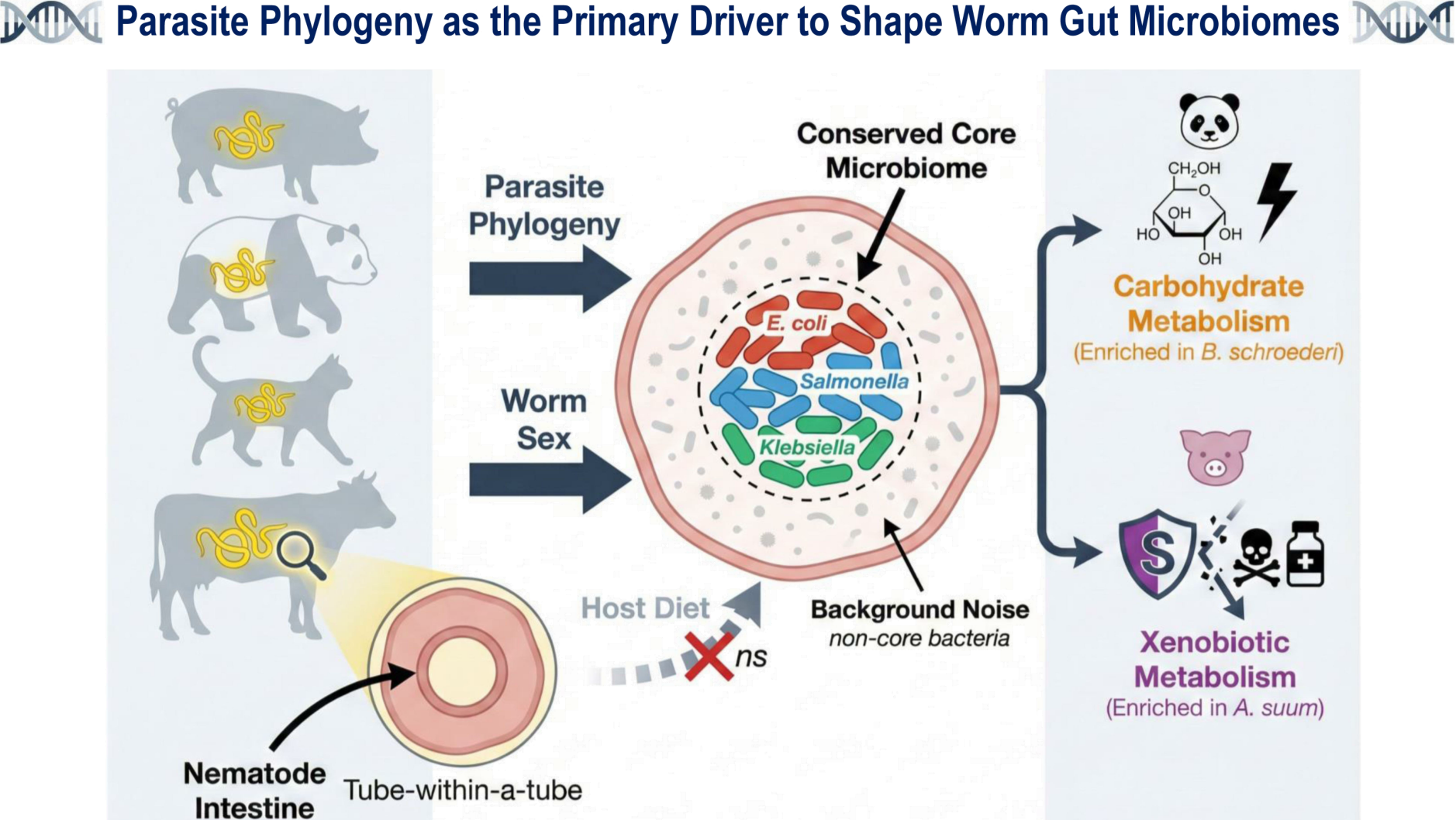
Roundworms are among the most widespread intestinal parasites in humans and animals, causing a range of health problems, including malnutrition, impaired growth, and immune dysfunction. While previous studies have focused largely on how these parasites influence the host gut microbiota, little has been known about the microbial communities that inhabit the parasites themselves. Using full-length 16S rRNA sequencing, the researchers systematically characterized the gut microbiota of four representative ascarid species: the pig roundworm (Ascaris suum), cat roundworm (Toxocara cati), cattle roundworm (Toxocara vitulorum), and giant panda roundworm (Baylisascaris schroederi). Despite infecting different host species, all four nematodes harbored remarkably similar microbial communities. Members of the family Enterobacteriaceae dominated the microbiota, with Escherichia coli, Salmonella enterica, and related bacteria accounting for more than 94% of the total abundance. Notably, the researchers found that microbiome composition closely reflected the evolutionary relationships among the parasites themselves. For example, the microbial communities of cat and cattle roundworms were more similar to each other than to those of the other species examined. This pattern, known as phylosymbiosis, suggests that host-associated microbial communities may have evolved alongside their parasitic nematode hosts. Further functional analyses revealed species-specific metabolic adaptations. The giant panda roundworm showed enrichment of carbohydrate metabolism pathways, whereas the pig roundworm exhibited enhanced capacities for xenobiotic degradation, potentially reflecting adaptation to differences in host diet and environmental exposures.
The work was supported by the National Natural Science Foundation of China, the Key Program of the Sichuan Science and Technology–Education Joint Fund, the Shanghai Pujiang Talent Program, and other funding sources.
Link: https://onlinelibrary.wiley.com/doi/10.1155/tbed/2764696