Recently, the Animal Schistosomiasis Research Team of SHVRI, CAAS, has made new progress in elucidating the molecular mechanisms underlying interactions between Schistosoma japonicum and its host. Focusing on microRNAs (miRNAs) carried by S. japonicum-derived extracellular vesicles (EVs), the research team discovered that parasite-derived sja-miR-2a-3p alleviates infection-associated hepatic fibrosis by regulating apoptosis in host hepatic stellate cells (HSCs). This study provides new insights into the molecular mechanisms underlying the long-term adaptation of schistosomes to their hosts. The findings have been published in the prestigious veterinary journal Veterinary Research.
Schistosomiasis is an important zoonotic parasitic disease. Infection with S. japonicum can cause severe hepatointestinal pathology, among which hepatic fibrosis represents a major pathological manifestation during chronic infection. Egg deposition in the host liver induces persistent inflammatory responses, promoting the activation of hepatic stellate cells and excessive production of extracellular matrix, ultimately leading to disruption of liver tissue architecture. Understanding the molecular interactions between schistosomes and their hosts is essential for identifying novel strategies for disease prevention and intervention targets.
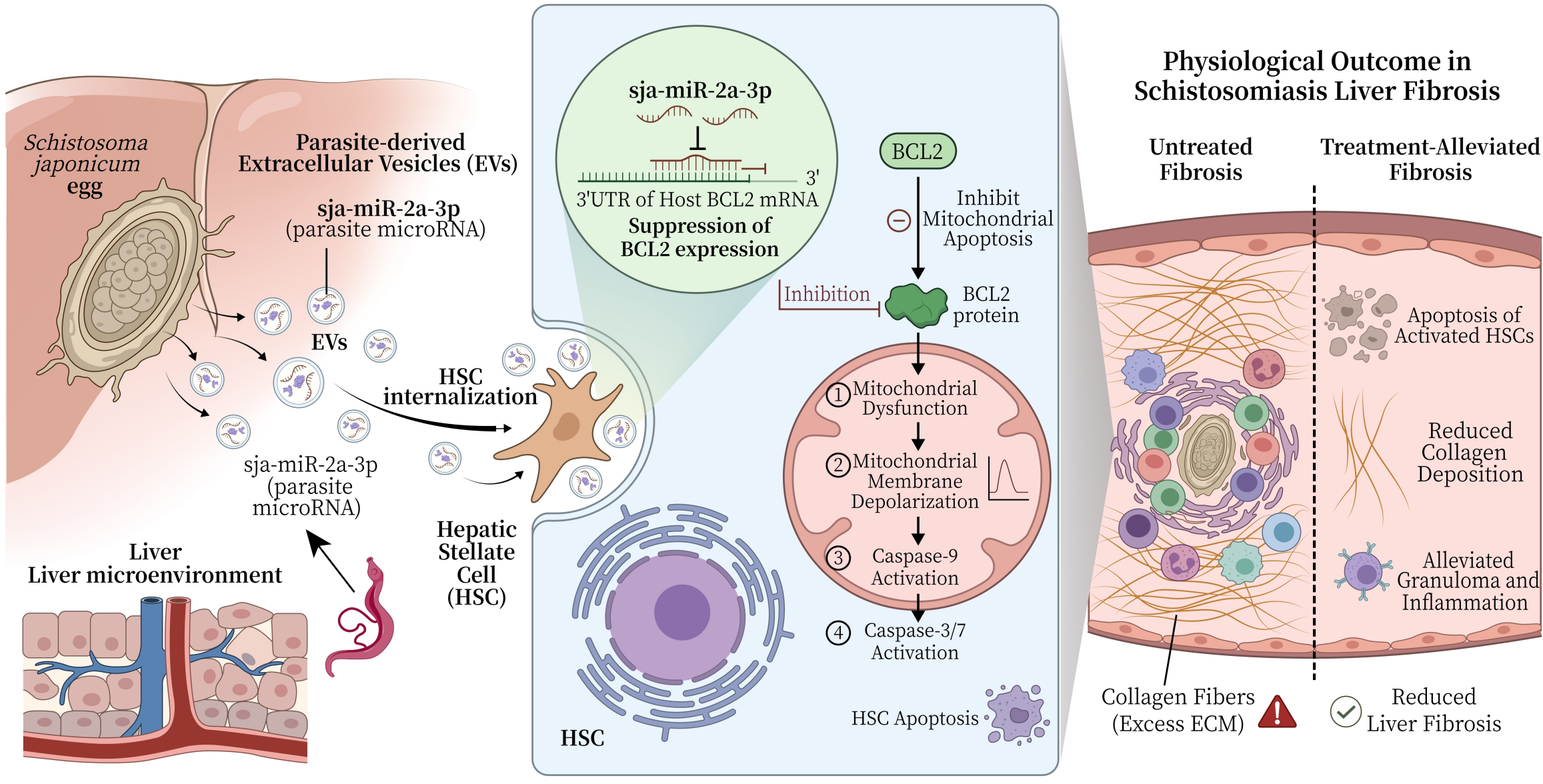
The research team first demonstrated that sja-miR-2a-3p could be delivered into host hepatic stellate cells through S. japonicum-derived extracellular vesicles.
Further investigations revealed that sja-miR-2a-3p directly targets the host anti-apoptotic gene BCL2, reducing BCL2 expression and thereby affecting the mitochondria-associated apoptotic pathway. Experimental results showed that sja-miR-2a-3p promotes apoptosis of hepatic stellate cells while inhibiting their proliferation, migration, and expression of fibrosis-related genes.
In animal experiments, the research team further verified the regulatory role of sja-miR-2a-3p in hepatic fibrosis progression following S. japonicum infection. The results showed that supplementation with sja-miR-2a-3p reduced fibrosis-associated pathological changes in the liver, suggesting that parasite-derived miRNAs may serve as important molecular regulators of host disease progression and potential candidates for anti-fibrotic therapeutic strategies against schistosomiasis.
This study reveals a novel mechanism by which S. japonicum regulates host cell fate through EV-mediated delivery of miRNAs, expanding our understanding of parasite–host molecular interactions and providing new theoretical foundations for schistosomiasis prevention and control, as well as the development of related therapeutic targets.
This research was supported by the Central Public-interest Scientific Institution Basal Research Fund, the Shanghai Sailing Program, and the Agricultural Science and Technology Innovation Program of CAAS.
Dr. Bowen Dong, a Ph.D. student at SHVRI, CAAS, is the first author of the paper. Researcher Yamei Jin and Assistant Researcher Haoran Zhong are the corresponding authors.
Link: https://doi.org/10.1186/s13567-026-01794-y